
.svg)

How CPUs Really Work: Understanding Computers Through 1s and 0s
(PUBLISHED)
28.01.2026
(WRITER)
lomax Team
(SOCIAL SHARE)

.svg)
%201.svg)

How CPUs Really Work: Understanding Computers Through 1s and 0s
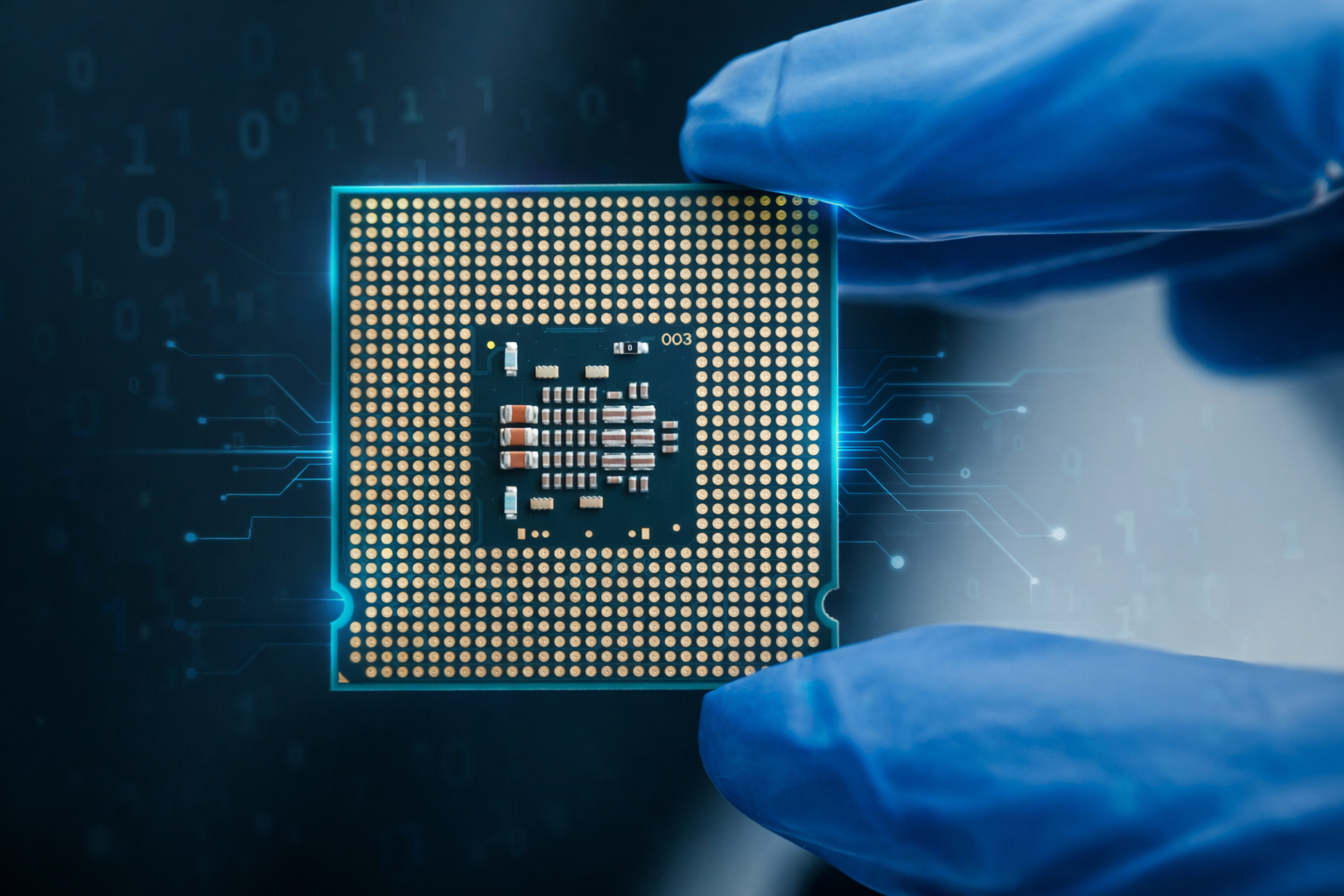
When you open a website, stream a video, run an ad campaign, or analyze data, something invisible but incredibly powerful is working nonstop behind the scenes: the CPU.
The Central Processing Unit is often called the brain of the computer, but how does it actually think?
Does it understand images, words, numbers, or strategy?
The surprising answer is simple:
A CPU understands only two things: 1 and 0.
In this article, we’ll break down how CPUs work, why binary logic is the foundation of all modern technology, and how everything from websites to artificial intelligence ultimately depends on electrical decisions happening billions of times per second.
What Is a CPU?
A CPU (Central Processing Unit) is the core component responsible for executing instructions inside a computer or server. Whether you’re using a smartphone, laptop, cloud server, or smart device, a CPU is always present.
Its main responsibilities are:
- Executing program instructions
- Performing calculations
- Making logical decisions
- Managing data flow between memory and hardware
Every click, scroll, or calculation you trigger is interpreted and processed by the CPU.
Why Do Computers Use 1s and 0s?
At the most fundamental level, computers are electronic machines.
Electronics naturally operate with electrical signals, which makes binary logic ideal.
- 1 = electrical signal present (high voltage)
- 0 = electrical signal absent (low or no voltage)
Instead of trying to process infinite voltage values, computers simplify everything into two stable states. This makes systems:
- Faster
- More reliable
- Easier to scale
- Resistant to electrical noise
Binary isn’t a limitation—it’s a strength.
Transistors: The Building Blocks of CPUs
Inside every modern CPU are billions of transistors.
A transistor is a microscopic electronic switch:
- ON → 1
- OFF → 0
That’s it.
But when you combine billions of these switches in carefully designed patterns, they can perform:
- Arithmetic
- Logical reasoning
- Data comparison
- Conditional decisions
Modern CPUs contain more transistors than there are people on Earth, all switching on and off at incredible speeds.
Logic Gates: How CPUs Make Decisions
A single transistor isn’t very useful on its own.
The real magic begins with logic gates.
Logic gates are small circuits built from transistors that perform basic decision-making tasks.
AND Gate
- Output = 1 only if both inputs are 1
OR Gate
- Output = 1 if at least one input is 1
NOT Gate
- Reverses the signal
- 1 becomes 0, 0 becomes 1
By combining these simple gates, CPUs can evaluate conditions like:
- Is this number bigger than another?
- Should the program continue or stop?
- Does this data match a condition?
Every “decision” your device makes is just logic gates reacting to electrical signals.
Binary Numbers: How CPUs Understand Math
Humans use base-10 numbers (0–9).
CPUs use base-2, also known as binary.
Example:
- Decimal 2 → Binary
10 - Decimal 3 → Binary
11
So when you calculate:
2 + 3 = 5
The CPU processes:
10 + 11 = 101
This calculation is performed using logic gates, not traditional math as humans understand it.
Math, at the CPU level, is controlled electricity.
Instructions: How Software Talks to Hardware
When you write code in languages like JavaScript, Python, or C++, the CPU does not understand it directly.
Instead, your code is translated into machine instructions, which look something like this:
- Load value
- Compare values
- Jump to memory address
- Store result
Each instruction ultimately resolves to patterns of 1s and 0s that control:
- Which transistors activate
- Which data paths open
- Which operation executes next
Even advanced systems like AI models or game engines are, at their core, executing massive chains of binary instructions.
The CPU Clock: Timing Everything Perfectly
To keep everything synchronized, CPUs rely on a clock signal.
The clock acts like a metronome:
- Each tick = one opportunity to process data
- Each tick triggers transistor state changes
For example:
- A 3.5 GHz CPU performs 3.5 billion clock cycles per second
At every cycle:
- Signals are evaluated
- Decisions are made
- Data moves forward
Higher clock speeds mean more decisions per second—but efficiency and architecture matter just as much.
Registers, Memory, and Data Flow
A CPU doesn’t work alone. It constantly communicates with:
- Registers (ultra-fast internal storage)
- RAM (temporary working memory)
- Caches (high-speed data buffers)
All data moving between these components is still just:
Streams of 1s and 0s
The CPU fetches instructions, decodes them, executes them, and stores results—repeating this cycle endlessly.
Why CPUs Generate Heat
Every time a transistor switches between 0 and 1, it consumes energy.
With billions of transistors switching billions of times per second, energy loss becomes heat.
That’s why CPUs need:
- Heat sinks
- Fans
- Liquid cooling (in high-performance systems)
More performance = more switching = more heat.
From Binary to Real Life
It may sound abstract, but binary logic powers everything around us:
- Websites and e-commerce platforms
- Digital advertising systems
- Analytics dashboards
- Cloud infrastructure
- Mobile applications
- Artificial intelligence
- Video streaming and gaming
At Lomax, when we design high-performance websites, advertising funnels, or data-driven platforms, all of it ultimately relies on CPUs efficiently processing binary logic at massive scale.
Why Understanding This Matters
You don’t need to be a hardware engineer to benefit from this knowledge.
Understanding how CPUs work helps you:
- Appreciate system limitations and performance bottlenecks
- Make smarter decisions in software, web, and infrastructure design
- Understand why optimization matters
- See technology as a logical system, not magic
Modern digital products succeed when design, logic, and performance align.
Despite their complexity, CPUs operate on a beautifully simple principle:
Everything is electricity and logic.
1 and 0.
On and off.
Billions of times per second.
From that simplicity comes the digital world we live and work in today.
At Lomax, we believe that understanding technology at its core allows us to build smarter, faster, and more scalable digital solutions—for brands that want results, not guesswork.


.svg)
.svg)
